
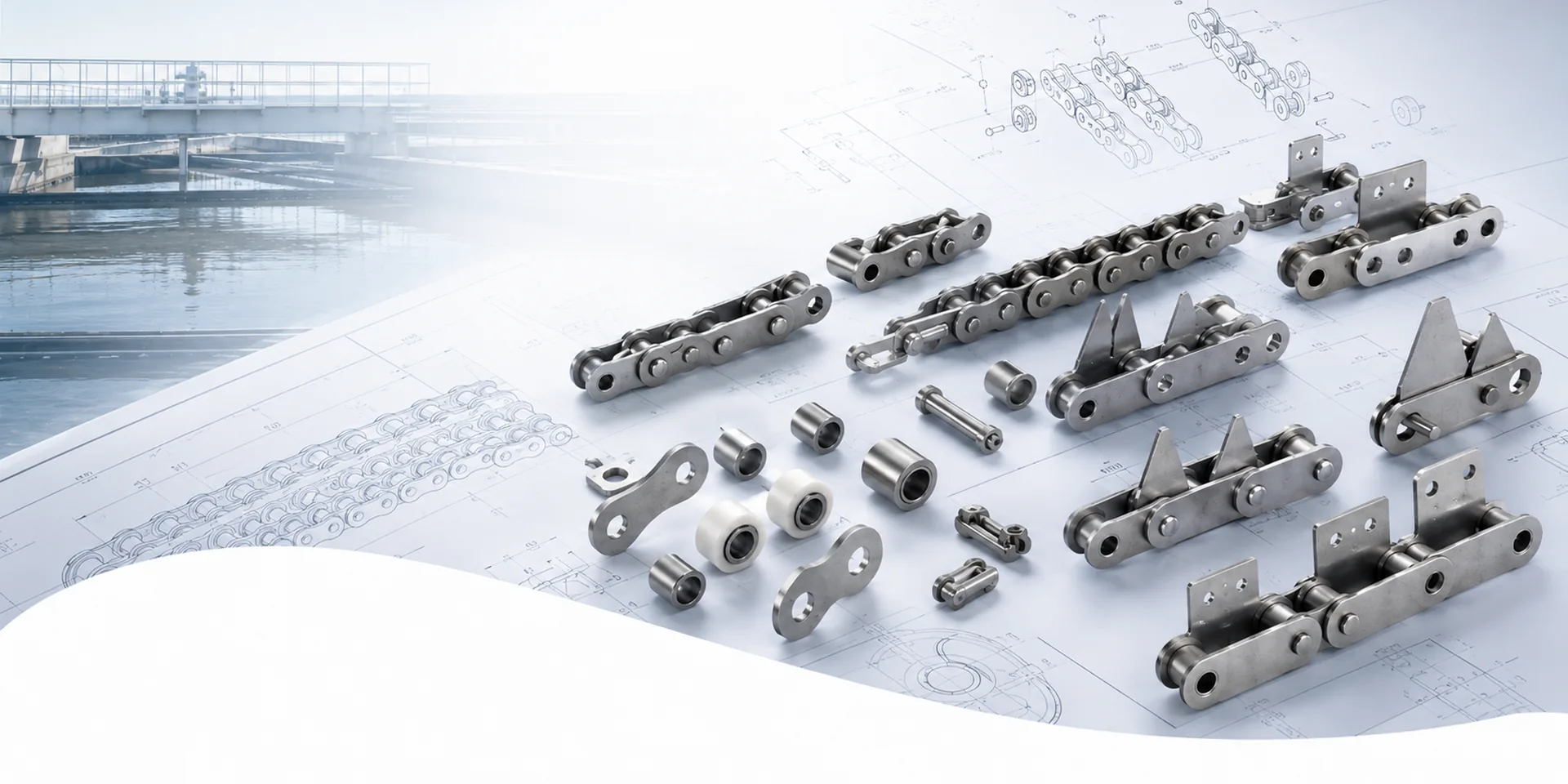
Abrasive Wear in Sewage Treatment Chains is best approached as an engineering decision rather than a catalogue lookup. The useful questions connect the chain to the equipment: grit ingress, bearing clearance, guide abrasion, sprocket wear, and solids accumulation. This guide explains how to collect that information, interpret the evidence and turn it into an RFQ that can be checked before production.
Wastewater chain systems often run at modest speed but in environments that combine water, solids, corrosion, abrasion and difficult maintenance access. Dimensional fit, articulation and attachment geometry can therefore be as important as nominal tensile strength.
The guidance is written for maintenance, OEM, EPC and procurement teams working with clarifiers, sludge and grit collectors, bar screens and other wastewater mechanisms. It does not replace the equipment designer’s safety review or the plant’s maintenance procedure.
Define the engineering decision before choosing a model
Write one sentence that states what must be decided. For this topic, record grit ingress, bearing clearance, guide abrasion, sprocket wear, and solids accumulation and separate fixed constraints from selectable options. Fixed constraints can include existing shaft centers, tank dimensions, guide locations and sprockets that will remain. Selectable options can include chain family, attachment detail, joining method and whether sprockets will be replaced.
This prevents a common problem: requesting an “equivalent” chain without stating the interfaces that define equivalence. The model name should narrow the search, while the measured geometry and operating duty decide fit.
If the chain is worn, note the wear location and reason for replacement. A replacement that copies the visible component without understanding the failure mechanism can reproduce the same problem.
Trace the load path through chain, attachment, flight and sprocket
A wastewater chain does more than transmit tension. Attachments move flights, rakes or scraper members; guides control the path; take-up absorbs installation and wear variation; and sprockets impose articulation every cycle.
Draw the circuit with direction arrows. Mark working and return runs, submerged zones, changes in elevation and points where grit or debris accumulates. Add drive and take-up sprockets with tooth counts when known. If the chain runs in pairs, record strand spacing and cross-member construction.
This system sketch is especially valuable when a replacement chain has the correct pitch but still tracks poorly, because it can expose guide offset, sprocket-plane error, flight distortion or an attachment mismatch.
Collect dimensions in a sequence that reduces ambiguity
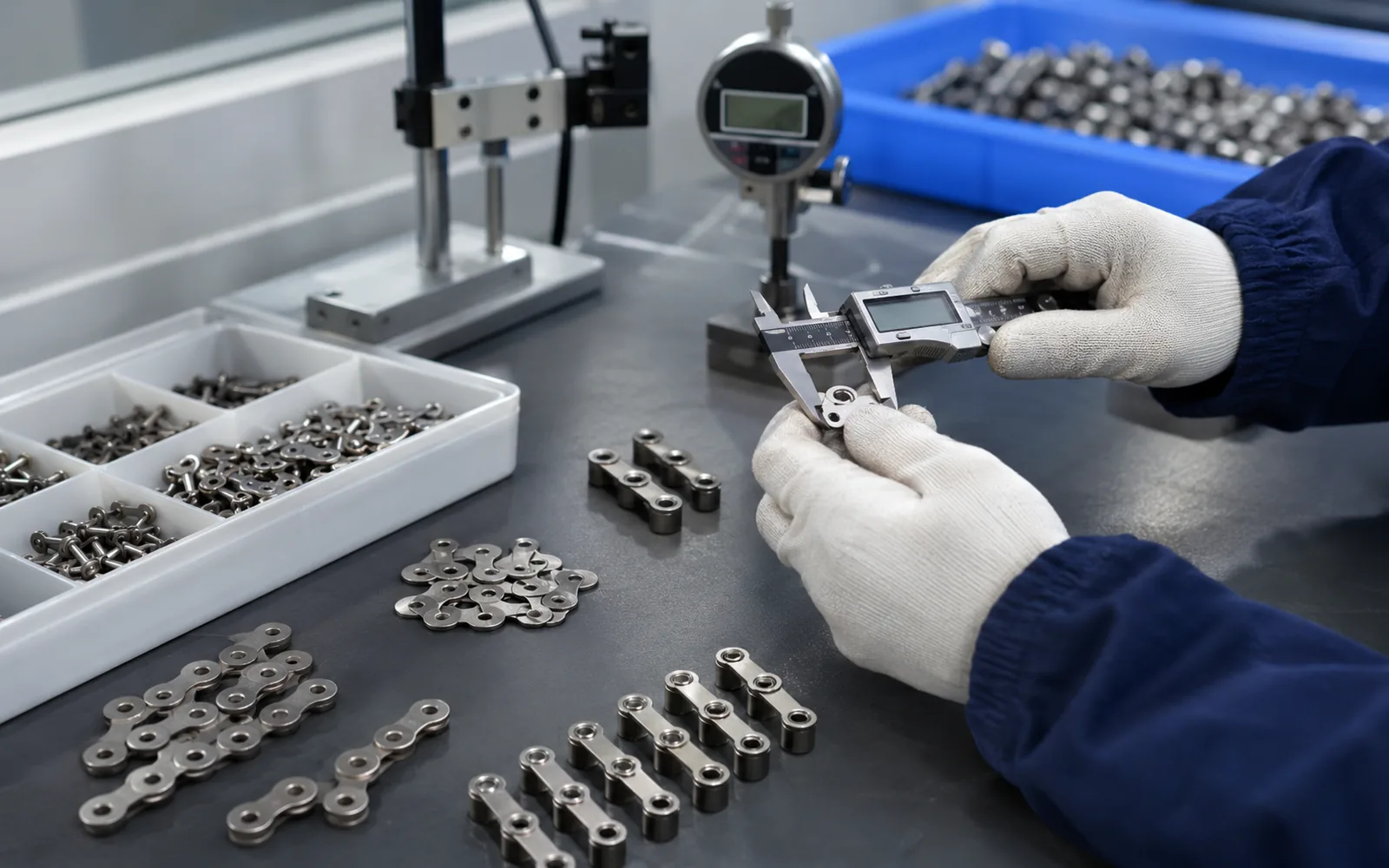
Start with pitch measured across several links. Then record working width, pin diameter, bush/barrel/roller diameter, overall pin length and link or plate height. For attachments, measure hole diameter, center distances, offset and the number of pitches between attachment stations.
Do not omit the sprocket. Tooth count, face width, bore/shaft data and visible tooth wear help confirm whether the chain is a true match. Long-pitch wastewater chains can be sensitive to how the link or barrel seats in the tooth space.
Photographs with a scale help document the field condition, but transcribe the actual value to avoid perspective error. For critical replacements, a sample plus a marked drawing is stronger evidence than either alone.

Use a screening matrix instead of one yes/no comparison
| Screening area | Question |
|---|---|
| Geometry | Does pitch, width, pin/bearing diameter, link profile and envelope match? |
| Attachments | Do hole pattern, offset, interval and flight connection match? |
| Sprockets | Will the chain seat correctly on the existing or proposed tooth profile? |
| Environment | Is the documented construction appropriate to submergence, grit, chemicals and temperature? |
| Maintenance | Can joining method, take-up and inspection points be serviced? |
| Commercial | Are length, strands, samples, mixed models and special processes clear? |
A model should progress only when the fixed interfaces are understood. If one item is unknown, convert it into an RFQ confirmation rather than assuming the most common configuration.
For family comparison, use the wastewater treatment chain catalogue. For unknown chains, use the replacement measurement workflow.
Plan inspection around trend, not surprise failure
Choose a repeatable chain-length measurement and record it at planned intervals. Add take-up position, attachment condition, guide wear and sprocket tooth condition. The trend shows whether wear is accelerating or concentrated on one strand.
Look for root-cause clues. Bright polished areas can indicate rubbing or misalignment. Localized pin/barrel wear can indicate grit ingress. Repeated attachment cracking can point to flight distortion. Hooked sprocket teeth suggest the old chain and sprocket have worn together.
Maintenance methods must match the chain construction and plant process. Do not import general roller-chain lubrication advice without confirming compatibility with the actual wastewater chain.

Convert the review into a quotation package
A strong RFQ identifies the product, interfaces, environment and commercial scope. Attach the model drawing or marked field sketch, list measured dimensions, identify attachment frequency, add sprocket data and state total chain length or number of pitches. For paired collectors, state the number of strands and whether cross members or flights are included.
Describe the operating issue if this is a replacement: corrosion, pitch elongation, seized articulation, attachment damage, sprocket wear, tracking problems or planned preventive replacement. This gives engineering a reason to look beyond simple dimensional equivalence.
For new clients, sample quantities of roughly 1–5 pieces can be evaluated at sample pricing where practical. Mixed-model industrial orders can be combined toward a USD 1,500 project value. Special materials, treatments, coatings or tooling follow their process minimums, and the site is not intended for one- or two-piece retail orders.
Frequently asked questions
What is the minimum information needed to start?
Provide the model if known, a drawing or sample, critical dimensions, attachment arrangement, sprocket details, application and quantity. For sewage chain abrasive wear, add the variables discussed in this guide.
Can a chain be identified from photographs only?
Photographs help identify construction, but they are not enough for a reliable replacement. Add measured pitch, widths, pin/barrel dimensions, attachments and sprocket data.
Should tensile strength be the first criterion?
No. Strength matters, but a chain that does not match the sprocket, attachment or guide geometry is still wrong. Establish fit and duty first.
How should unknown material be handled?
Do not infer a grade from appearance. State the environment and mandatory material requirements, and keep the exact construction as an RFQ confirmation if the source does not define it.
How do I compare supplier quotations?
Use the same controlling drawing and scope. Check attachments, joining pins, sprockets, special processes and documentation before comparing unit prices.
Baseline data to record before installation
Before a new chain enters service, record the multi-pitch length, take-up position, sprocket condition, attachment fastener state and representative guide clearances. For a project centered on sewage chain abrasive wear, add the specific measurements or environmental observations that drove the selection. Photograph the drive, take-up and at least one typical attachment station.
This baseline turns future shutdown inspections into a trend comparison. Without it, maintenance teams can see wear but cannot easily tell how fast it developed or whether one strand began with a different setting.
When drawings, catalogues and samples disagree
Older wastewater equipment can contain a mixture of original parts, later replacements and field modifications. If the catalogue designation, archived drawing and removed sample disagree, do not silently choose one source. Mark the conflicting dimensions and identify which mating components will remain in the machine.
The production order should name one controlling drawing or agreed dimension set. A documented discrepancy is manageable; an undocumented assumption can become an installation problem after the shutdown has started.
Sprocket evidence that should be collected with the chain
Photograph the chain seated on the drive sprocket before removal. Record tooth count, face width, shaft or bore arrangement and any hooking, thinning or one-sided wear. If the old chain has elongated, the sprocket may have worn to the elongated pitch and should not automatically be reused with a new chain.
Where sprocket replacement is not planned, that constraint becomes part of chain selection. Where it is planned, evaluate the chain and sprocket geometry as one new interface rather than two independent catalogue items.
Attachments, flights and load path
Attachments should be specified by geometry and by what they do. Record hole centers, offset from the chain centerline, plate thickness, attachment interval and the way the flight, scraper or rake connects. Then mark the direction of process load. This shows whether the attachment transfers a centered load or introduces bending into the base link.
On paired collectors, consistent attachment timing is essential because a small difference between strands can rack a flight and produce uneven guide or sprocket loading.
A practical shutdown decision sequence
Use the latest inspection trend to decide what should be ready before the equipment is stopped. If chain elongation, attachment damage and sprocket wear are all present, prepare the complete replacement scope early enough to verify drawings, samples and commercial quantities. If only one localized component is damaged, investigate the cause before replacing the whole circuit.
Pre-shutdown preparation should also identify joining method, required tools, handling space, take-up reset position and the sequence for checking alignment after installation.
Procurement and RFQ control points
For sewage chain abrasive wear, the quotation request should use the same technical scope across suppliers: model or drawing, measured dimensions, attachments, sprockets, operating environment, total length or quantity, special processes and required documentation. Ask proposed deviations to be stated rather than hidden inside an “equivalent” description.
This makes commercial comparison more meaningful and preserves a usable technical record for the next maintenance cycle. Mixed-model project orders can be grouped, while samples and special processes should be identified separately so their production minimums are clear.
Measurement uncertainty and field data quality
Field measurements for sewage chain abrasive wear should be repeatable enough that another person can reproduce them. Use the same reference faces, remove loose debris, measure several links, and record the instrument and units. A long multi-pitch measurement reduces the influence of local wear, but only if the chain is straight and the reference pins are clearly identified.
When access prevents a direct measurement, mark the limitation on the sketch instead of filling the gap with a nominal value. Separate measured dimensions from catalogue values and from assumptions. This simple notation prevents an assumed dimension from being treated as verified data later in the quotation process.
Distinguish the failure mechanism from the visible symptom
A cracked attachment, elongated pitch or worn sprocket tooth is a symptom; the cause may be elsewhere in the circuit. Review alignment, flight distortion, solids accumulation, guide interference, take-up balance and operating events before deciding that material alone is responsible. On paired chains, compare the two strands because unequal loading can produce different wear rates even when both chains were supplied together.
Root-cause thinking matters for replacement specifications. If the new chain simply copies the old geometry while the guide or sprocket problem remains, the new component can fail in the same way. The RFQ should state the observed symptom and any suspected system cause so engineering can ask the right follow-up questions.
Chain and sprocket replacement economics
Replacing sprockets adds shutdown scope, but retaining badly worn sprockets can shorten the useful life of a new chain. Evaluate tooth profile, seating marks, face wear and shaft alignment against the measured condition of the old chain. If the old chain has significant pitch growth, determine whether the sprocket has worn to that elongated pitch.
The commercial decision should consider access and shutdown cost, not only the sprocket purchase price. Where the drive is difficult to reach, replacing a questionable sprocket during the planned chain shutdown can be less disruptive than reopening the system after new-chain engagement problems appear.
Documentation that makes repeat orders easier
After the final chain is approved, keep the controlling drawing, attachment schedule, sprocket data, inspection requirements and commercial line item together. Add installation photographs, initial take-up position and the baseline multi-pitch measurement. This record becomes the technical source for the next repeat order.
For plants with several collector trains, create a simple equipment-to-chain schedule. Label each model by equipment, strand count, length, attachment interval and drawing revision. That reduces model-name confusion and helps buyers combine related industrial items into one RFQ without losing technical clarity.
Site acceptance and commissioning checks
Before the equipment returns to normal service, verify chain direction, joining-pin installation, sprocket engagement, guide clearance, attachment orientation and take-up position. Turn the mechanism slowly through a complete circuit and watch the points where the chain changes direction or passes the tightest guides. For paired strands, confirm that flights remain square and neither strand becomes noticeably tighter.
Record any adjustment made during commissioning. If a field change is necessary, update the maintenance record and the controlling drawing rather than allowing the installed configuration to drift away from the purchase specification. That discipline is one of the simplest ways to improve the next replacement cycle.
Final pre-order technical checkpoint
Before the purchase order is released, review the drawing, measured field data and quotation as one package. Confirm that the quoted model and attachment configuration match the same revision used for the sprocket and equipment interface review. Check the chain length or number of pitches, strand count, joining method, attachment interval, special processes and any required documentation.
If an item is still unknown, keep it as a written confirmation rather than allowing production to proceed on an unstated assumption. This final checkpoint is especially useful for shutdown work, where a small dimensional mismatch can create more cost than the component itself. A concise signed-off data set gives purchasing, engineering, production and maintenance one common reference.