
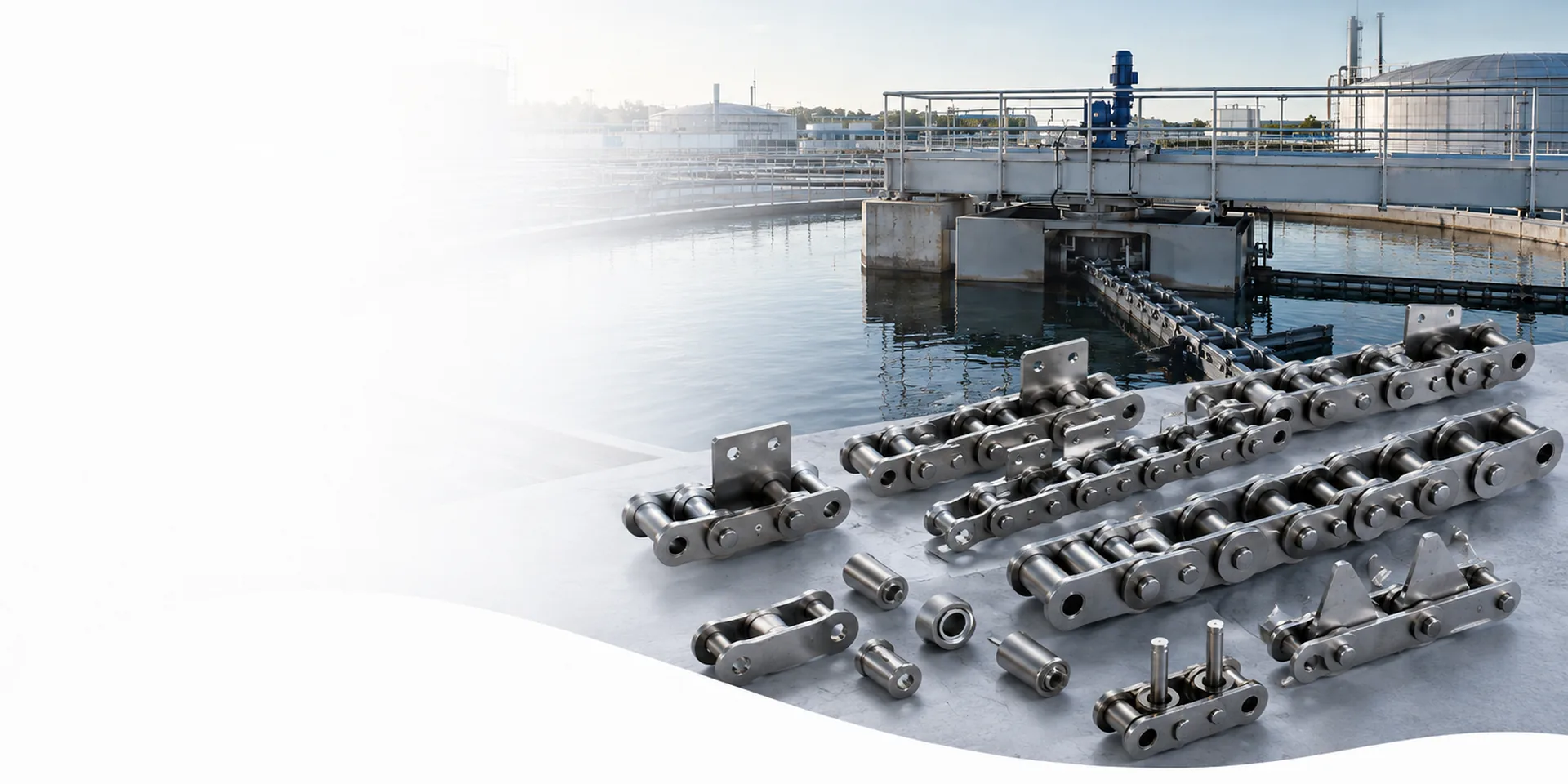
Choose a wastewater chain by construction and equipment interface
Start with the chain family that matches the installed mechanism, then compare pitch, working width, pin or barrel geometry, attachments and sprocket engagement. The model pages below keep dimensional information close to the product so replacement and project enquiries can be checked efficiently.
For an existing plant, the most reliable starting point is a model number, a marked drawing or a removed sample measured together with its sprocket. For a new collector or screen, provide the chain path, shaft centers, attachment spacing, flight or rake interface, duty conditions and expected quantity.
Compare wastewater-chain families by construction, geometry, operating environment and the equipment interfaces that control replacement fit. Nonmetallic Wastewater Chains for industrial wastewater treatment and collector equipment. Compare model geometry, attachments, sprockets and operating duty before ordering. Stainless Steel Wastewater Chains for industrial wastewater treatment and collector equipment. Compare model geometry, attachments, sprockets and operating duty before ordering. Wastewater Collector & Pintle Chains for industrial wastewater treatment and collector equipment. Compare model geometry, attachments, sprockets and operating duty before ordering.Wastewater treatment chain families
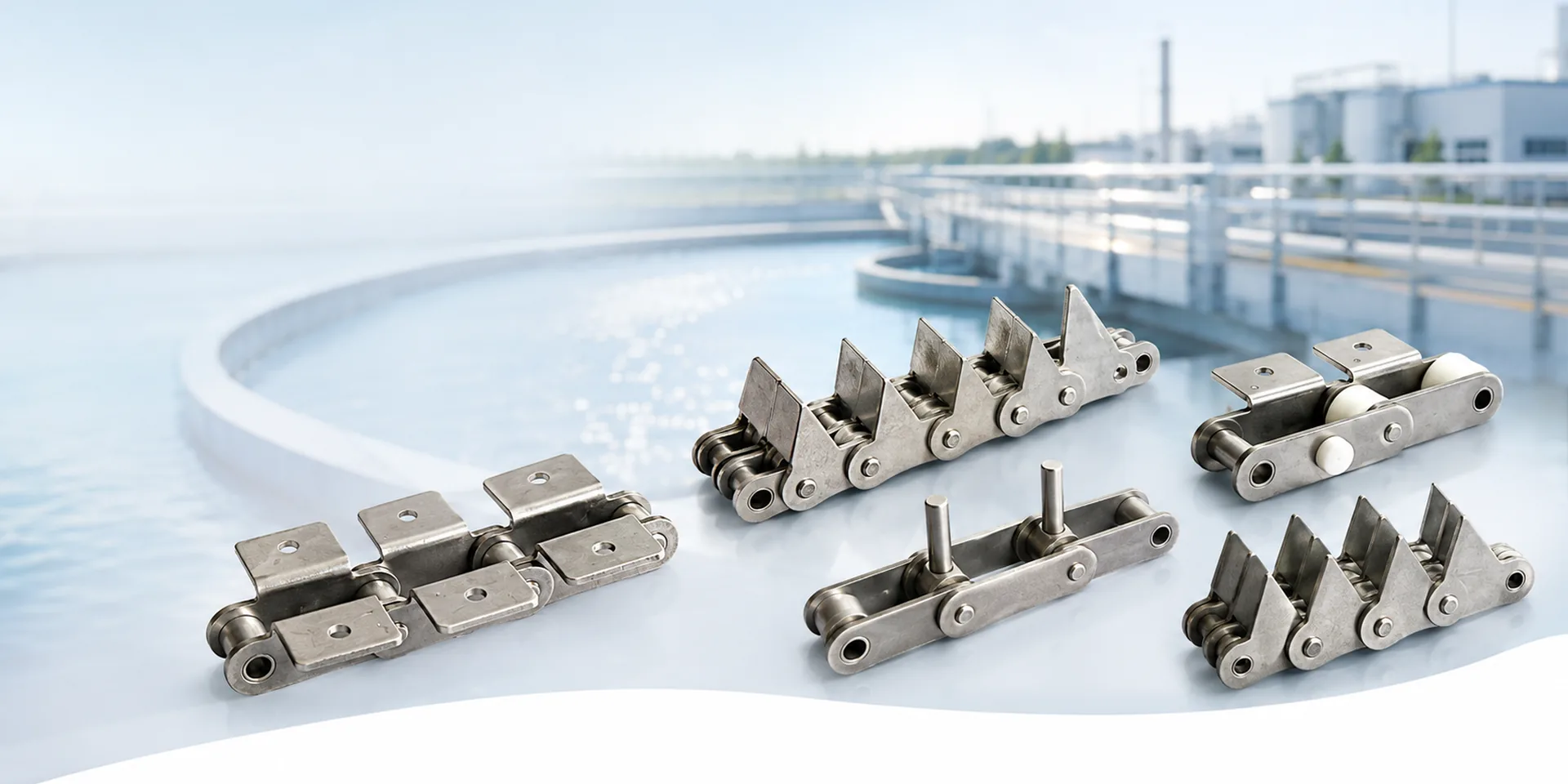
Nonmetallic Wastewater Chains
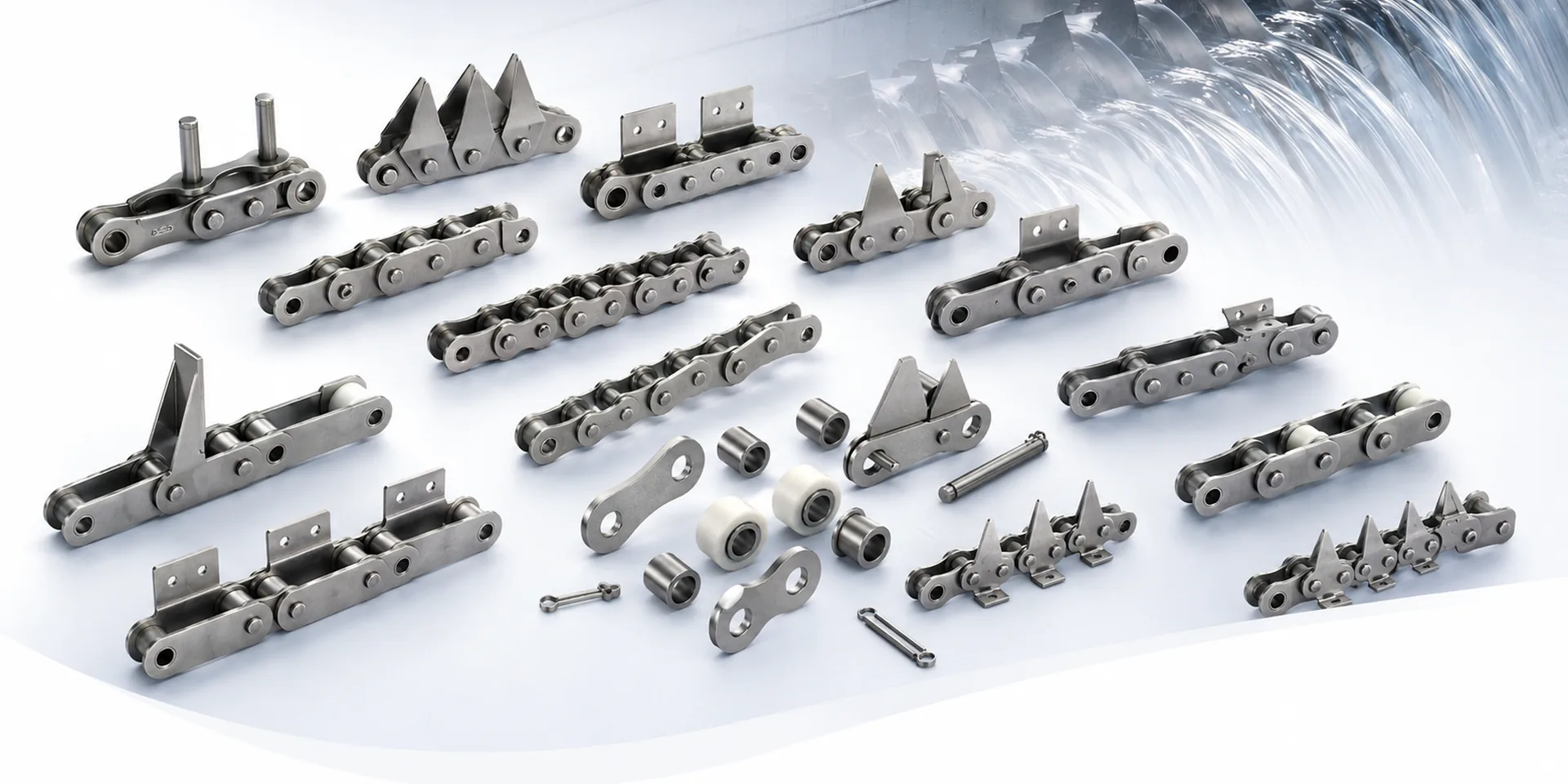
Stainless Steel Wastewater Chains
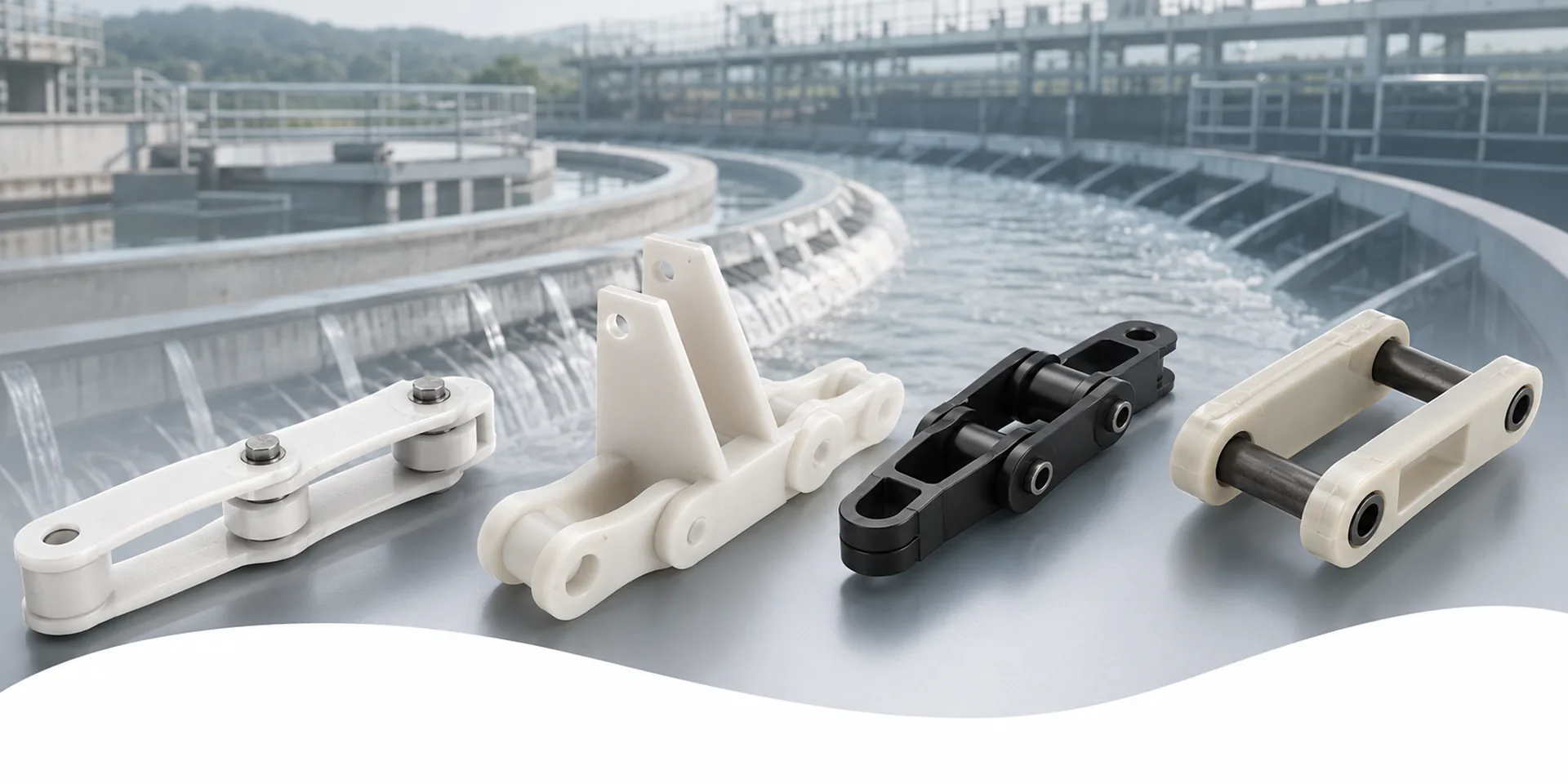
Wastewater Collector & Pintle Chains
Four checks before you compare model numbers
Confirm pitch, bearing or barrel diameter, working width, overall pin length and link profile.
Record attachment style, hole centers, offsets, flight connection and the interval between attachment stations.
Count teeth, record face width and shaft or bore data, and note hooked or one-sided tooth wear.
- Measure several pitches instead of one worn link.
- Photograph the chain seated on the sprocket before removal.
- Identify whether the working run is submerged or exposed to grit.
- Record strand spacing when two chains carry common flights.
- Mark dimensions taken from a drawing separately from field measurements.
- State the total chain length, number of strands and required quantity.
The chain is one part of a larger collector mechanism
Clarifiers, sludge collectors, grit systems and bar screens impose different load paths and access constraints. A dimensionally similar chain can still be unsuitable when attachment timing, guide clearance or sprocket seating differs.
Use the wastewater application guides to identify the process variables that should accompany a product enquiry, then use the replacement measurement guide when the installed chain cannot be identified confidently.
Use construction as a filter, not as proof of interchangeability
Review exact grade requirements, geometry, attachment drilling, sprocket material and corrosive or abrasive exposure. Stainless construction does not remove the need to check guide contact and tooth engagement.
Confirm the exact formulation for the selected model, temperature, sustained load, chemistry, sprocket face and guide material. Similar model numbers are not proof that two nonmetallic series are equivalent.
Compare pitch together with link profile, working-load data, attachment family, joining construction, sprocket face and the equipment path. Several 700 Class models share nominal pitch but remain separate configurations.
| Question | Useful evidence | Decision |
|---|---|---|
| Will the chain fit? | Multi-pitch length, working width, pins/bearings, link envelope and attachment drawing | Confirms physical compatibility with guides and flights. |
| Will it engage? | Sprocket tooth count, face width, shaft alignment and tooth condition | Checks seating and whether mating components can remain. |
| Will it suit the duty? | Water chemistry, solids, grit, debris, cycle pattern and shock history | Identifies which material and wear mechanisms need review. |
| Can it be supplied as required? | Length, strands, joining pieces, attachments, quantity and inspection documents | Defines a comparable industrial RFQ scope. |
Keep the final drawing and installation baseline with the equipment
After a successful replacement, retain the approved drawing revision, final chain length or pitch count, joining components, attachment schedule and sprocket information. Add the initial take-up position and a few photographs showing the installed chain and a typical attachment.
That record changes the next order from a re-identification exercise into a controlled repeat check. If the plant later changes a flight, guide, sprocket or attachment, update the equipment record so the next quotation is based on the mechanism that is actually running.
When several models are needed for one project, list each line separately by equipment and drawing, then combine the commercial enquiry. This preserves technical traceability without preventing mixed-model project supply.
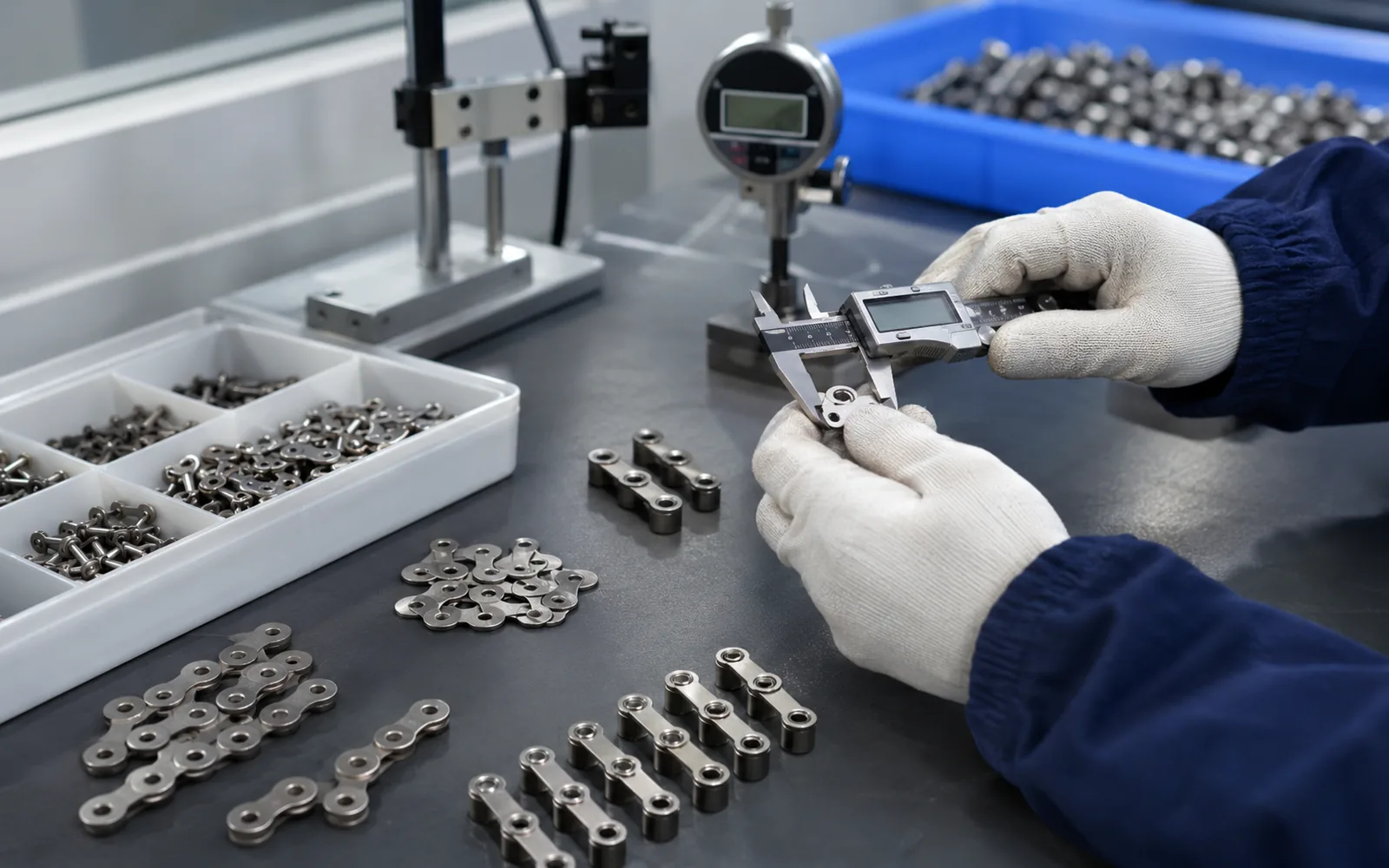
Send the model or drawing, measured dimensions, attachment details, sprocket information, application and quantity. If the chain is unknown, include clear photographs and a sample when practical.